


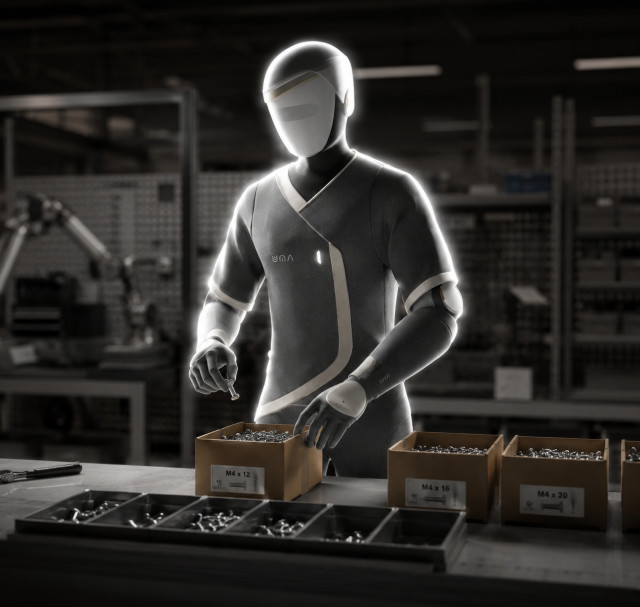
- At Machina Summit, UMA unveils the design of its first humanoid robot and introduces Real-Time Learning, a new AI architecture that enables robots to learn new skills through demonstration rather than programming.
The announcement comes as aging populations, industrial reshoring, and the energy transition place increasing pressure on labor markets across advanced economies. According to Korn Ferry, the global economy could face a shortage of 85 million workers by 2030, representing as much as $8.5 trillion in unrealized economic output. Against this backdrop, UMA is developing a new generation of intelligent robots built to assist people by taking on physically demanding, repetitive, or hazardous work.
“Demographic, industrial, and environmental challenges all point to the same reality: societies need greater productive capacity,” said Rémi Cadène, CEO and co-founder of UMA. “We believe intelligent robots will become part of the solution, not as a substitute for people, but as a new class of tools that enables them to devote more time to what machines will never replace: creativity, judgment, innovation, and caring for others.”
Robotics Designed for the Real World
For UMA, humanoid robotics is not about building technology demonstrations. It is about developing robots capable of creating immediate value in environments already built for people, including factories, warehouses, logistics centers, and industrial facilities. Their humanoid architecture enables them to use existing tools, integrate seamlessly into current infrastructure, and collaborate naturally alongside existing teams.
This engineering approach extends beyond hardware. By interacting with the physical world in ways that mirror human behavior, UMA's robots can learn more efficiently from demonstrations, receive guidance when necessary, and continuously improve their performance in operational environments.
While much of today's humanoid robotics industry oscillates between highly mechanical machines that showcase engineering complexity and consumer-inspired products designed to appear friendly, UMA has deliberately chosen a different direction.
UMA has chosen a different direction. This is what UMA calls the dressed machine: its robot combines human-scale proportions with a neutral visor instead of facial features, eliminating ambiguity between person and machine. A soft technical outer shell is paired with intentionally visible mechanical joints, embracing the robot's identity rather than concealing it.
Rather than optimizing for short-lived demonstrations, UMA has engineered its robot to earn trust through everyday use. The objective is not to build a machine that impresses on stage, but one that integrates naturally into industrial operations and becomes a reliable partner over time.
Real-Time Learning: Teaching Robots the Way People Learn
At the heart of UMA's platform is a simple conviction: future robots should learn the way people do.
When people encounter a new task, they observe, experiment, practice, and progressively improve until they master it. Real-Time Learning applies the same principle to robotics by allowing robots to acquire new capabilities from demonstrations, adapt to unfamiliar situations, and continuously refine their execution through experience.
Instead of requiring engineers to manually reprogram robots for every new application, the platform enables robots to continuously learn from their environment, making them significantly more flexible and easier to deploy across a broad range of industrial settings.
As Cadène explains, the industry's challenge is no longer building robots capable of executing individual tasks. The next breakthrough lies in building robots capable of learning new ones.
Building Physical AI in Europe
While today's humanoid robotics race is largely driven by the United States and China, UMA believes Europe offers a unique opportunity to lead the next chapter of Physical AI.
The region combines world-class scientific research, a strong industrial base, and growing demand for automation driven by structural labor shortages. For UMA, Europe is not simply where the company was founded, it is where intelligent robots can create value the fastest.
Technology That Expands Human Potential
Today‘s unveiling represents more than the introduction of a humanoid robot. It reflects UMA’s broader vision for Physical AI: intelligent machines capable of continuously learning, adapting, and working alongside people to address some of society's most pressing demographic, industrial, and environmental challenges.
“We're still at the beginning of this journey,” said Cadène. “Humanoid robots will take years to reach large-scale deployment, just as the internet and smartphones required time before transforming entire industries. We believe intelligent robots will reshape the physical economy in much the same way.”
“One day, robots will contribute to manufacturing future generations of robots, accelerating their own deployment. But our ambition has never been to replace people. It is to expand what people are capable of, to give everyone more time to create, solve problems, and focus on what makes us uniquely human. That vision guides every scientific, technological, and industrial decision we make at UMA.”
About UMA
UMA is a European Physical AI company developing the next generation of intelligent humanoid robots.
Founded in 2025 by Rémi Cadène, Pierre Sermanet, Robert Knight, and Simon Alibert, the company combines expertise in frontier AI, robotics, embodied intelligence, embedded systems, and industrial engineering to build robots capable of learning through demonstration and operating safely in real-world environments.
Headquartered in Paris, with teams across London and Geneva, UMA is building a Physical AI platform designed to help industries address labor shortages while enabling people to focus on higher-value work.
View source version on businesswire.com: https://www.businesswire.com/news/home/20260707215927/en/
언론연락처: Outcast France for UMA Yana Rogers +33 698335048 Nalia Kailali +33 652755653
이 뉴스는 기업·기관·단체가 뉴스와이어를 통해 배포한 보도자료입니다.
ⓒ 주식회사 에이아이크리에이티브랩 & www.aifilmjournal.com 무단전재-재배포금지
BEST 뉴스
-

Esri to Debut the Power of Where Collection at 2026 Esri User Conference
Esri (https://www.esri.com/en-us/what-is-gis/overview), the global leader in location intelligence, will debut the Power of Where Collection (https://powerofwhere.com/?aduc=Public_Relations&aduca=2026-MUL-Esri_Press_Books&aduco=press-release&adum=Press_Release&adut=pow-series&... -
Statement on Terminating the Letter of Intent With AI Financial Corporation
Statement from Matthew Nicoletti, Chief Strategy Officer, Perpetuals.com (Nasdaq: PDC), on the proposed transaction with AI Financial Corporation. “Perpetuals has decided not to further pursue the acquisition of AI Financial Corporation’s subsidiary Alt5 Sigma Canada, Inc. and the earlier letter... -

디자인 툴 필요없다… 비즈뿌리오, 알림톡 전용 ‘이미지 메이커’ 출시
비즈뿌리오 ‘이미지 메이커’ 기능 출시 기업 메시징 서비스 비즈뿌리오를 운영하는 다우기술(대표 김윤덕)은 카카오톡 알림톡에 포함되는 이미지를 손쉽게 완성할 수 있는 ‘이미지 메이커’ 기능을 지난 1일 출시했다고 밝혔다. 최근 카카오톡 알림톡은 단순 텍스트 형태를 넘어 브랜드 로... -
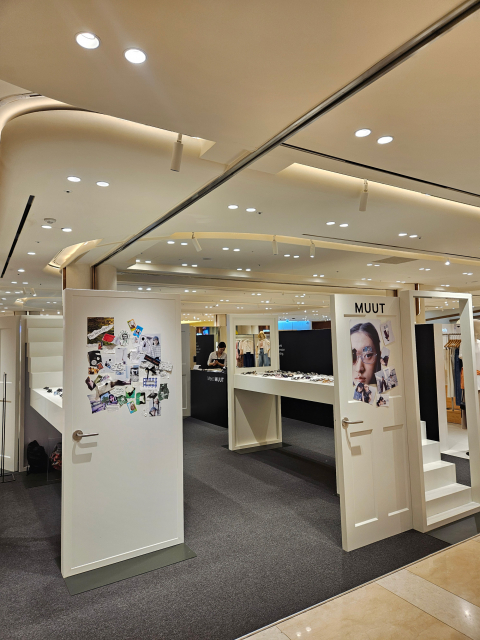
MUUT, 신세계 강남점 입성… 롯데 잠실 이어 팝업 확대
신세계 강남 MUUT 팝업 전경 패션 아이웨어 브랜드 뭍(MUUT)이 7월 9일부터 22일까지 신세계백화점 강남점 5층 팝업 스테이지에서 팝업 스토어를 운영한다. 이번 팝업은 MUUT의 다양한 아이웨어 제품과 브랜드가 제안하는 스타일을 직접 경험할 수 있는 공간으로 꾸며졌다. 롯데월드몰 잠... -

글렌알라키 ‘15년 컬렉터스 에디션 PART I’으로 JPM 어워즈 금상 수상
글렌알라키 15년 컬렉터스 에디션 파트 1 프리미엄 주류 수입 유통사 메타베브코리아는 자사의 대표 싱글몰트 위스키 브랜드인 글렌알라키의 한정판 패키지 ‘글렌알라키 15년 컬렉터스 에디션 PART I’이 일본 마케팅 업계 최고 권위의 시상식인 ‘제54회 Japan Promotional Marketing Award... -
소비자는 부담 덜고, 어가는 판로 확대… GS더프레시 ‘ESG 장어덮밥’ 출시
GS리테일이 운영하는 슈퍼마켓 GS더프레시는 국내산 민물장어 소비 촉진을 위해 ‘국내산 통한마리장어덮밥’을 출시한다고 14일 밝혔다. 이번 상품은 GS더프레시가 한국어촌어항공단, 해양수산부와 함께 추진하는 ‘Co:어촌 프로젝트’ 일환으로 기획됐다. Co:어촌 프로젝트는 기업의 상품 개발·유통 역량과 국내 어가의 ...
전체댓글 0
NEWS TOP 5

실시간뉴스



추천뉴스



포토뉴스
more +-

노매드헐, 일본항공과 손잡고 리버풀 FC 우먼 경기에서 여성 스포츠 임파워먼트 축하 행사 개최
전 세계 60만 글로벌 여성 여행자 커뮤니티 앱 노매드헐(NomadHer)이 일본항공(Japan Airlines, 이하 JAL)과 공식 파트너십을 맺고 여성 스포츠의 활기찬 정신을 기념하는 특별 협업 프로젝트를 진행했다고 밝혔다. 이번 협업을 통해 노매드헐 커뮤니티 회원들이 한자리에 모여 리버풀 FC 우먼(... -

KYMF대한민국청소년미디어대전, 9월 18일까지 작품 공모
시립청소년미디어센터는 국내 최대 규모의 청소년 미디어 축제인 ‘2026 제26회 KYMF대한민국청소년미디어대전’(이하 미디어대전)의 작품을 오는 8월 1일부터 9월 18일 오후 6시까지 공식 누리집(https://kymf.ssro.net)을 통해 공모한다. 서울특별시가 주최하고 시립청소년미디어센터가 주관하... -

라이온코리아, 여름철 빨래 냄새 특화 ‘비트 몬스터 팟 10X냄새케어’ 이마트서 1+1 행사
건강한 생활 습관을 만드는 기업 라이온코리아가 고온다습한 날씨로 실내건조가 많아지는 여름철을 맞아, 전국 이마트에서 하이브리드 캡슐세제 ‘비트 몬스터 팟 10X냄새케어’의 1+1 행사를 진행한다. 라이온코리아는 실내건조에 특화된 ‘비트 몬스터 팟 10X냄새케어’의 접근성을 높이고 소비자... -

이너스커뮤니티, 오뚜기 진라면 서포터즈 ‘진앤지니’ 18기 발대식 성료… 12년째 이어온 ‘팬덤’ 마케팅
하이브리드 브랜딩 기업 이너스커뮤니티(INUSCommunity)가 기획·운영하는 오뚜기 대학생 진라면 서포터즈 ‘진앤지니’ 18기가 지난 7월 6일 오뚜기라면 공장에서 발대식을 열고 공식 활동을 시작했다. ‘진앤지니’는 2012년 첫 기수를 시작으로 올해 18기를 맞은 국내 대표 장수 서포터즈 프로그...